Tuesday, December 05, 2006


Thursday, November 02, 2006
La judicatura defiende al consumidor
Antes de la era digital, las sociedades de autores cobraban su canon a los medios de comunicación, bares, restaurantes, radios, etc, es decir, a los lugares que radiaban música y que se lucraban, supuestamente, con ello - aumentando así su clientela.
Nunca en esos tiempos las sociedades de autores le cobraban un canon a los consumidores, a los compradores, a los ciudadanos de a pie, a las gentes que no se lucraban con sus productos. Y eso era lógico y tenía sentido. El hombre de la calle, o la mujer, iba a una tienda de vinilos, después de compactos, y adquiría, compraba, pagaba, por un disco, que se llevaba a su casa, no para lucrarse, sino para gozar de la música que había comprado. Este mismo individuo, podía hacerse tranquilamente una copia de su vinilo o de su compacto en cinta magnética, usando su magnetofón o su grabador de cassettes, para escuchar la música que habia comprado, en el radio-casette de su coche, o en el reproductor de cassettes de su apartamento de verano, o en el de su oficina, o en su walkman unos años después. Y hasta aquí todo estaba muy bien.
Pero ahora, en la era digital, lo que antes se podía hacer sin pagar peaje, sin pagar impuestos: la copia privada, ahora no se puede hacer sin pagarle a las sociedades de autores el mismo canon que les cobran a los medios de difusión que funcionan por el lucro. Ahora, al consumidor final, se le supone un lucro monetario que no se produce, que no existe, por el solo hecho de hacerse una copia privada del producto comprado, un acto tan antiguo como el magnetófono.
Las sociedades de autores justifican este cambio tan perjudicial para el consumidor con la idea de que el consumidor llega a prescindir del producto original de fábrica y se conforma con copias privadas hechas a partir de discos propiedad de sus amigos o conocidos, cosa que ya ocurría antes de la era digital, cuando muchos consumidores se bastaban con tener las cassettes-copia de ciertos productos musicales, sin comprar los discos originales, de mayor calidad audio, porque simplemente no les interesaban hasta tal punto como para comprarlos.
Como la copia digital de un disco compacto es idéntica en calidad audio al original, evidentemente la compra del original pierde cierto interés, a no ser que el libreto que viene con este valga la pena, o quizás un cupón de descuento para ir a un concierto, y otros extras que las discográficas incluyan con el disco compacto original para hacer la compra realmente atractiva, por ejemplo: un autógrafo genuino del artista.
Pero la situación está en que el consumidor paga un canon que antes sólo pagaban las emisoras y empresas que se lucraban con la música radiada, cuando este consumidor no se lucra para nada. Y lo peor de esto es que el consumidor que paga este canon puede ser un individuo que jamás se hace copias privadas de discos musicales, ni de los propios ni de los ajenos. Puede ser un señor que usa soportes de memoria digital exclusivamente para guardar sus fotos, para guardar sus documentos, para guardar sus videos, etc, es decir, para guardar obras de su propia autoría, o para guardar archivos simplemente privados, ajenos al mercado; en todo caso: que no tienen nada que ver con los autores cuyos intereses gestionan las sociedades de creadores e intérpretes musicales.
Por eso es muy interesante que la judicatura en España comience a reconocer: (1) Que no hay delito en realizar copias privadas digitales de discos musicales de propiedad propia o de propiedad ajena, es decir, prestados. Porque la copia privada y la circulación libre de copias digitales de obras musicales, no atenta contra el negocio de los artistas sino que les hace propaganda gratuita, y tampoco atenta contra el negocio de los sellos discográficos, porque ellos venden la música con una presentación exclusiva y unos extras que hacen su producto, que es un objeto material, atractivo. (2) Y que no hay razón ni justificación alguna para que el consumidor pague un impuesto sobre todos los soportes de memoria digital que adquiere, bajo la erronea presunción de que los va a usar para archivar copias de obras musicales. Tal impuesto, además, resulta abusivo, indiscriminado y extraordinariamente oneroso para el consumidor, produciéndole un efecto de rechazo hacia la industria musical y sus productos, en lugar de incentivar la compra de los mismos.
Por otra parte, el tal impuesto, o canon, clama a los cielos una inspección del fisco, porque las sociedades de autores no explican ni transparentan cómo distribuyen, los cuantiosos ingresos que les genera, entre sus socios miembros. Puesto que no hay manera de saber cuántas copias digitales privadas se han grabado de las obras de un intérprete musical determinado, la sociedad que defiende sus intereses no tiene manera de abonarle el estipendio correspondiente derivado de ese tráfico digital, y si le abona una cantidad no puede saber si le paga demasiado o demasiado poco, ya que ha de repartir proporcionalmente esos ingresos entre sus representados. Este factor de oscuridad, implícito en la gestión del canon una vez cobrado por las sociedades de autores, lo delata como un mecanismo de atraco al ciudadano de a pie, para lucro de unos gestores, sin que los mismos representados tengan arte ni parte; es decir, el canon funciona en la práctica como un botín de pirata.
Tanto es así que, ya que en la era digital todos somos autores: de fotos, de videos, de textos, incluso de tonadillas, podríamos ir todos los ciudadanos a inscribirnos en las sociedades de autores, para que al final del mes nos pagaran lo que nos pertenece a cuenta (o a cuento) del cobro del canon sobre soportes de memoria, repercutido por tráfico de archivos digitales copiados de un lado a otro de la red (o de la agenda personal de contactos).
Por eso, viendo lo absurdo del caso, de todo lo que tiene que ver con la opaca gestión de las sociedades de autores musicales, con sus políticas de piratería contra el consumidor que les da de comer, son muy buenas noticias las que nos da la prensa sobre los jueces de España fallando a favor del consumidor, a favor de la circulación libre de copias digitales privadas de obras musicales (y videográficas, y fotográficas, y literarias), y contra el canon cargado a discos duros, a cd-rom's y dvd's vírgenes, a toda clase de chips de memoria, que no tienen porque ser usados para acumular copias de obras musicales, ¡y aunque así fuera!. Fallos judiciales que dan a entender que el negocio musical debe ir por otros derroteros: sin interferir con la facultad de difusión libre y gratuita de la cultura por medios digitales. Que hagan su negocio como siempre: con sus productos materiales, y con sus actividades en vivo. Pero que dejen en paz al mundo digital, que no es su enemigo sino su mejor escaparate.
Tuesday, October 10, 2006
Net Neutrality
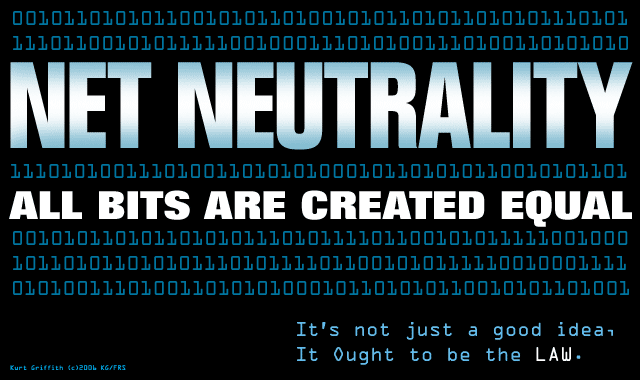 This site supports a Neutral Internet.
You already pay for your connection.
You have the right to access any site
from any Internet connection provider.

Wednesday, September 20, 2006
We think the same, Cory
"I believe that we live in an era where anything that can be expressed as bits will be. I believe that bits exist to be copied. Therefore, I believe that any business-model that depends on your bits not being copied is just dumb, and that lawmakers who try to prop these up are like governments that sink fortunes into protecting people who insist on living on the sides of active volcanoes. Me, I’m looking to find ways to use copying to make more money and it’s working: enlisting my readers as evangelists for my work and giving them free ebooks to distribute sells more books. As Tim O’Reilly says, my problem isn’t piracy, it’s obscurity. Best of all, giving away ebooks gives me lots of key insights into how to make money without restricting the copying of bits. It’s a win-win situation." -- Cory Doctorow (site).
Tuesday, September 19, 2006
Nada parará la cultura digital
Querido Teddy: No se pueden poner puertas al campo. Los archivos digitales van a seguir circulando entre la gente, distribuyéndose gratuita y libremente. Lo que teneis que hacer (los autores y editores) es ofrecer productos atractivos que la gente quiera comprar en las tiendas, a precios razonables; cosas que un archivo digital no les pueda dar. También debeis concentrar vuestra energía en cobrar del intérprete, que es el que se lucra de vuestras obras (de autor), cuando ofrece conciertos. Toma por ejemplo los cines: mucha gente sigue yendo a ellos para disfrutar una película a pantalla panorámica, con sonido extraordinario, en plena oscuridad... todo eso que es una experiencia única que un film en DVD o en archivo digital no les puede dar. Haced lo mismo con los conciertos, promoved audiciones de alta fidelidad cobrando entrada. Sed creativos, caramba! Puesto que vuestro negocio no podrá jamás ni parar ni aprovecharse del fenómeno digital, teneis que apostar fuerte por el negocio analógico, off-line, en vivo, por el producto material, etc, es decir, por todo lo que no es digital, ni duplicable, ni reproducible.
Friday, September 08, 2006
P2P y derecho a la cultura, libre y gratuita
7 de Septiembre de 2006
Sentencia absolutoria en España por intercambio de archivos en Internet
via David BravoMi comentario:
Los archivos digitales que contienen música, textos, imágenes, películas... deben ser gratuitos, porque de hecho carecen de coste de duplicación, y porque la cultura es un bien universal.
Mucha gente confunde "música" con "archivo digital", y "bit" con "átomo".
Está muy bien que un CD editado por una discográfica con todo lujo de carátula y libreto, tenga un precio en las tiendas, porque se está vendiendo un objeto fisico, un producto material, hecho de átomos. También está muy bien que unos intérpretes musicales den conciertos y cobren entrada: están ofreciendo música en vivo, algo imposible de experimentar de otra manera que estando allí. Los autores de los temas musicales pueden cobrarles derechos a los intérpretes, cada vez que toquen su música y/o letras en concierto. También les pueden cobrar esos derechos a las discográficas, por cada CD material (hecho de átomos) que se venda.
Pero a diferencia de lo anterior, los archivos digitales están hechos de bits. Esos bits son fácilmente duplicables y sin costo apreciable. Los legisladores deben tolerar la circulación libre y gratuita de archivos digitales, como potente herramienta para extender la cultura a todos los ámbitos de la sociedad.
Si al lado de esa circulación libre, P2P, de archivos digitales, hay quien pone una tienda para venderlos (tipo iTunes, Unbox, etc), pues que pague derechos e impuestos a quien corresponda y que se atenga a los correspondientes permisos.
Siempre habrá, como usuario, quien prefiere ir a comprar un producto físico a una tienda física, o un producto virtual a una tienda virtual, y en ese sentido adelante con las iniciativas de negocio dentro de la ley. Pero debe permitirse legalmente que quien se quiera tomar la molestia de pescar una copia privada gratuita en las profundidades de la red, lo pueda hacer amparado por el sacrosanto derecho a la cultura libre y gratuita.
Thursday, August 31, 2006
Pirate Party: Manifesto 2006 (Introduction)

Preface
The election program of the Pirate Party consists of various nautical charts, describing what we want to do in each of the areas within the Pirate Party policies. These charts are divided in sections based on deadline and what is to be done on a Swedish and on a European level.
As an introduction to these charts, we describe our ideology and our main policies.
Protected integrity in an open society
The development of technology has made sure Sweden and Europe stand before a fork in the road. The new technology offers fantastic possibilities to spread culture and knowledge all over the world with almost no costs. But it also makes way for the building of a society monitored at a level unheard of up until now.
In no time, the monitoring state has advanced its positions strongly in Sweden. This development threatens equality and safety before the law, and nothing indicates that it even adds to security. The Pirate Party believes this is the wrong way to go.
The right to privacy is a corner stone in an open and democratic society. Each and everyone has the right to respect for one’s own private and family life, one’s home and one’s correspondence. If the constitutional freedom of information is to be more than empty words on a paper, we much defend the right for protected private communication.
The arguments for every individual step towards a monitoring society may sound very convincing, but we only have to look at the recent history of Europe to see where that road leads. It is less than twenty years since the fall of the Berlin wall, and there are numerous other terrible examples. To claim that it’s only those with something to hide that has anything to fear is simply lacking knowledge of history, and lacking courage.
We have no problem with police monitoring and spying on suspected criminals. That is exactly what the police is suppose to be doing. But routinely monitoring ordinary citizens hoping for something suspicious to turn up is not only a gross violation of the privacy of honest people. It is also a waste of valuable police resources.
We have to pull the emergency break on the train running towards a society we don’t want. Terrorists can attack our open society, but only governments can disband it. The Pirate Party wants to ensure that this doesn’t happen.
Private communication and file sharing
A driving force behind the current monitoring hysteria is the entertainment business, which wants to prevent people from file sharing copyrighted material. But to achieve this all private communication must be monitored. To know what ones and zeros make up a movie, the ones and zeros has to be analyzed. It is the same sort of ones and zeros that is sent, regardless of if it makes up a piece of music, or a letter to a doctor or a lawyer.
Therefore society ha to choose: do we want a possibility to trustingly communicate over the Internet to exist?
If your answer is yes, it means that also those that shares copyrighted material can use these possibilities.
If you answer is no, it means that you abolish the right of information, the right to mail secrecy and the right to a private life.
There are no other answers.
It is not possible to claim that society should allow mail secrecy for certain purposes, but not for others, since it is impossible to separate the different cases without breeching the secrecy. It is the same types of ones and zeros being used, and only by opening the message, it is possible to see what it contains.
The current copyright legislation can not be combined with freedom of information and protected private communication. Since the fundamental principles of the open, democratic society is more important than conserving old business models within the business of entertainment at all costs, copyright has to fold.
But this is not negative. A reformed copyright legislation, expressing a balance between different interests in society instead of being an order form from the large media companies, has its own benefits. It is a possibility for Sweden and Europe, not a threat.
The spreading of culture and knowledge is a positive thing
Thanks to the Internet it is today possible for everyone with a computer to take part of a fantastic treasure of culture and knowledge.
Instead of being limited to a cultural canon decided from above, the youths of today has access to the music, theater and pictures of an entire world. This is something we should embrace, not something we should try to forbid. File sharing is good for society and its people.
All non-commercial acquiring, using, bettering and spread of culture should be actively encouraged. The Internet is filling the same function today as popular education did a hundred years ago. It is something positive and good for the development of society.
The copyright legislation must be changes so that it is made perfectly clear that it only regulate use and copying of works done for commercial purposes. To share copies, or in any other way spread or use someone else’s work, should never be forbidden as long as it is done on an idealistic basis without the purposes of commercial gain.
Unfortunately, the legislation has developed in quite the opposite direction. On July 1, 2005, a million ordinary Swedes were suddenly turned into criminals over night, simply because they download movies and music. This doesn’t only hurt our possibilities to take part of culture. In the long run it undermines the trust of our entire judicial apparatus. This development has to end.
In a similar fashion, patents are used to inhibit the spread and use of knowledge, which hurts society as a whole.
Medical patents make people in poor countries die for no reason. It twists the priorities in research and makes the costs for medications a problem in every health care budget.
Software patents inhibit technical development within the info tech area and presents a serious threat against small as well as mid-sized businesses and individual developers. They run the risk of putting the power over the Internet completely in the hands of a small number of multi national businesses.
We want to release knowledge, and have specific suggestion on how to avoid the negative consequences that the patent system means.
Sweden and Europe has everything to gain from choosing the path of openness.
No other issues
The Pirate Party does not have any policies on issues that traditionally concerns the left-right scale, or any other issues outside of our program of policiies.
We particularly does not concern ourselves with the division of wealth. We are not after dividing money between different groups in society. None of our propositions costs any money for the state, and several of them may potentially save money in the budget. Because of this, we can place ourselves outside of the struggle concerning the budget, with good faith, and leave it to the old parties.
We are ready to support a social democratic as well as a non-socialist government, we claim that both Göran Persson as well as Fredrik Reinfeldt are well capable of taking the role as the head of government in a satisfactory manner. We do not believe that the differences between them are that big, in reality, and every one of us are ready to live with any of them as our prime minister.
The only thing that concerns us, is the protection of our open society and democracy, that the march towards a controlled society is cancelled, and that culture and knowledge are set free.
Our goal is to reach the parliament and being in a position where we can tip the scale. If we succeed in this we will talk to both Göran Persson and Fredrik Reinfeldt alike. We will explain what we want, and point out that our policies in no way differs from either traditional social democratic policy or traditional liberal/non-socialist policy.
After that, we will support the person aspiring to form a government, who is ready to make the best deal with us on our policies. On any matter outside of our policy statement, we will support and vote for the current government, no matter what we believe individually on different matters.
Due to the fact that we do not have a view on everything on this earth, but concentrate completely on the issues where we have formed a policy, we can promise a result if we make it to the house of parliament in a scale-tipping position. That makes us unique in Swedish political history.
We are the only party that will never deal away our free and open society for the benifit of any other issue or interest.
More on the Pirate Party tipping the scale
The Pirate Party does not take a stand in issues generally associated with the right or left, or any other issues that are not part of our declaration of principles. We are ready to support a socialdemocratic as well as a non-socialist government. The only thing that concerns us is that the march towards a controlled society is cancelled, and that culture and knowledge in society are set free,
On of the factions within Swedish politics has really anything to lose in reality by satisfying more or less all of our demands. Neither Persson nor Reinfeldt have any personal interest in keeping the absurdity that is current copyright legislation. The fact that things look like they do, is primarily due to lack of interest in the area, and that they have therefore allowed the ‘experts’ (i.e. the lobbyists of the entertainment industry) have their way.
In a situation where they can gain position of forming a government by striking a deal with us in an issue that they, themselves, believe to be less important, there is every reason to believe that they will be eager to find a solution.
But in either case, there are three possible scenarios:
1) One of the factions agree to our demands, and the other does not. Then we will choose the faction that agree with us. Whether this is the red faction of the blue faction is of no concern for us. As long as we see that they are doing their best to seriously run our issues, we will support the government in all other issues as well, without questioning.
2) Both the factions agree to our demands. If there are differences of nuances making one faction looking slightly better than the other, we will choose this faction. If both are exactly as good, we will support the faction with the more votes. This way we won’t influence the balance between the factions in Swedish politics. As long as the government is running our issues, we will support them in all decicions, just as in the first scenario.
3) Both the factions refuse to meet our demands. This is the more complicated case, but we can handle this one too. Initially we will support one faction, and make a government possible. Most likely this will be the ones with the less votes, so that the others, the ‘victors’, will feel that they have lost power they were entitled to. They can, however, not do much about it, since we will support the government without questioning in anything that does not involve our principles.
When the “victors” are safely placed in the penalty box of opposition, we start our businesslike, low-voiced conversations with them, until they realize that our proposals are not, in fact, that dangerous, and that they can only win from working with us. When they have seen our arguments in the glow of the miraging governmental position for a while, there are good reasons to believe they will agree with us. This is when we will call for a vote of non-confidence and change the government. After that, the Pirate Party with support the new government without questioning, in all issues, as long as the government runs our issues forcefully, just as in scenario 1 and 2.
This is our entire strategy. This way we can guarantee that our policies will have a break-through.
Questions and answers about our scale-tipping strategy
- How do we handle parliamentary votes that do not include any issues that the Pirate Party runs?
We will support the government in office, no matter what our personal opinions might be.
- Will the party try to make deals with other parties (”if you vote for us on issue “X” and “Y” we will help you with “Z”)?
No, we will talk to the party in office. As long as they do as we want in our issues, we will support them in all other matters. We do not wish to try shopping a la carte from different parties (if we do, we will only be shoved aside). If the government stops this manner of cooperation, we will change the government, but as long as we tolerate a government, we are completely loyal to them in all other issues, those not in our program.
- …or not vote?
If the government needs our support in the parliament it can count on it. We will not cancel our votes if this would affect the turnout against the government.
- …or let the individual MPs decide for themselves?
Under no circumstances. The day we start voting after personal preference, we have nothing more to offer the other parties in a negotiation. If this happens, we can no longer benefit from our position, and have no longer any means to influence the policies that is the closest to our hearts.
- But in the third scenario (that is if none of the factions wants to offer anything at all, even though we are tipping the scale), why would we want to support the government? We should obviously be able to offer them to vote, from their perspective, in an unseemly manner? It seems a bit awkward to give them what they want first (by support) and then trying to negotiate.
The idea in the third scenario is that we help a government form, that we ourselves aren’t happy with, but who we choose to support indefinitely anyway. Principally only to tease the opposition, in other words. When the opposition has spent a few months being grumpy because they can’t form a government even though they think they won the election, they have two alternatives to choose from. They can either stay grumpy for the next four years, or they can start talking to us to find out if they can “talk sense in to us” and have our support.
The big prize is the government, both for the left and the right, and they have nothing to lose from having a dialogue with us. With that, we’ve managed to initialize a discussion with the opposition concerning these issues. Since our proposals does not, in any way, clash with the basic values of neither the left wing nor the right wing block, and since they are good proposals, objectively, for Sweden, there is no reason to believe that they would prefer to stay grumpy for the next four years instead of making a deal with us.
But until they have done so, we will consistently vote with their opponents (i.e. the government that we support even if we think they are no good). That way the opposition will have an even bigger reason to strike a deal with us, even more so than if we voted without a clear direction. The more votes the opposition loses concerning health care / education / taxes / disbanding of military units, the more eager they will become to have a change of government.
The government that is in power even though we think they’re no good will perhaps feel happy to be able to carry through whatever they want without giving us anything in return. But they will know that all it takes for them to lose office is one word from the opposition. So the joy they’re feeling will hardly be very deep or long lasting.
The point of helping a government to form even if none of the players gives us what we want is that we want to add to stablity and let things calm down a bit. One can’t postpone negotiations about the government more than a couple of weeks after the election. If we can’t have a government that we want because it promises to see our points and work for them, it’s still better to help a government we don’t like. The country needs a government.
Parliamentarism is such an ingenious system because the parliament can throw out the government in office whenever a majority of its members wish. The leader of the opposition will know this, no matter if his name is Persson or Reinfeldt. So why would he not talk to us to see if he can create a majority for a vote of no confidence? And why would he not meet our demands when he has had time to think about them, and realize that they do not oppose his own ideology or any core party issues in any way?
If we make it to the parliament, but can not tip the scale
Even if we would not reach a position where we can tip the scale, we can still do a lot of good in the standing committees. Much of the malfunctioning legislation that is voted through is often voted through because the established parties do not understand the Internet and all the new technology. They have not thought through the consequences of building a controlled society to conserve the old instead of embracing the possibilities we have in our time.
They often blindly trust what lobbyists and civil servants at the departments tell them to think. They do not see these issues as important enough to put down time getting an informed opinion.
We can hopefully change this, simply by being part of the committees, pressing the fact that these are important issues. Neither social democrats nor moderates really want to make it illegal for small businesses to develop new software, after all, or put all Swedish youths in prison. The fact that they still make or argue for laws that has these consequences is mostly due to lack of knowledge. We can supply the standing committees with a well needed competence and a valuable perspective.
- If we can’t tip the scale, will we try to negotiate about individual issues?
In this scenario, negotiations will hardly be our most important tool, simply because we wouldn’t have much of a negotiation position. If they can create a majority without us, they won’t need to negotiate with us at all.
But this does not mean that all would be lost. We could still add a lot, simply by being constructive in our committee work. Much of the worst legislation is due to the fact that the established parties lack knowledge and interest in our issues.
- …or will we simply cancel our votes?
In a situation where there is a parliamentary majority without us, it wouldn’t matter how we voted, and then it doesn’t make a difference. The simplest thing would be to simply not vote.
- …or do we present bills that are promptly turned down?
We might want to present bills as part of our work to clarify the choices our society has, but the purpose then would only be to raise these issues. We would probably have to spend more time discussing the pros and cons of the bills that are about to be clubbed.
- …or should we simply stay home with our kids?
Participating in the committees in a constructive manner aside, there will be much work to be done on the European level. Some of the decisions we want carried through can only be made in Brussels. Therefore we have all reason to do what we can to support our sister parties in other countries, and help them get started. So there might not be much time for vacation, even if we don’t get to support a government.
Wednesday, March 08, 2006
P2P: the new cultural global paradigm
Peer to Peer and Human Evolution
From Wikipedia, the free encyclopedia
Peer to Peer and Human Evolution is an essay by Michel Bauwens that expands the P2P meme beyond computer technology. It argues that egalitarian networking is a new form of relationship that is emerging throughout society, and profoundly transforming the way in which society and human civilization is organised. The essay argues that this new form of non-representational democracy is a crucial ingredient in finding the solutions to current global challenges; as well as a new and progressive ethos representing the highest aspirations of the new generations.
See also
External links
- Peer to Peer and Human Evolution - Pdf version - the original essay, a dialogue with the integral community
- Peer to Peer and Human Evolution - revised html version (the most recent revision - a much expanded general version)
- Manifesto at P2P Foundation wiki
- Peer to Peer and Human Evolution - introduction at Kheper
- The P2P civilisation reviews and synopsis, at Arthuriana - Discussion Groups for Arthur Magazine and Bastet
From the Integral Wiki article "Peer to Peer and Human Evolution"
Source: Wikipedia
Tuesday, March 07, 2006
BITS vs ATOMOS
Bits contra Atomos: la batalla por la creación
Bit, unidad de información: uno o cero. La era digital.
Hasta hace poco, la producción de los artistas y creadores tomaba forma material.
Los arquitectos construyen edificios. Los escultores y pintores crean esculturas y pinturas.
Los actores y bailarines usan su cuerpo y su voz para expresar emociones y dar vida a personajes.
Los músicos componen partituras o tañen sus instrumentos en concierto.
Los fotógrafos y cineastas captan imágenes en película que luego imprimirán en papel o proyectarán sobre una pantalla.
Los poetas, novelistas y ensayistas producen manuscritos o ejemplares mecanografiados, encuadernados como pliegos o como libros.
Edificios, esculturas, lienzos, cuerpos humanos, violines, partituras, películas, diapositivas, fotografías y libros, están hechos de átomos.
Por mucho tiempo, los artistas -como arquitectos, escultores, pintores, actores, danzarines, músicos, fotógrafos, cineastas y literatos, se ganaron la vida vendiendo sus obras hechas de átomos, que se podían poseer y tocar, o ver y escuchar en directo.
Si las artes tratan de agradar o de informar los cinco sentidos, habría que añadir entre los artistas a los cocineros, a los decoradores, a los modistas y a los perfumistas. Todos ellos obtienen su sustento vendiendo su habilidad de arreglar los objetos, elementos y al final átomos que afectan a uno o varios sentidos. Es decir, en forma de platillos comestibles, de mobiliario y adornos para el hábitat, de ropa y accesorios para vestir o de aromas para la piel.
Los literatos fueron los primeros creadores, artistas o autores, en descubrir que su obra se podía replicar por un número indefinido de ejemplares. Así, el autor literario, inauguró el modelo del cobro en serie por una obra. El editor, productor de la tirada de libros, entregaría al autor un porcentaje de los beneficios o de las ventas. Fue la primera revolucion en la difusión de la cultura. Todo gracias al bueno de Gutenberg, inventor de la imprenta.
Mientras tanto, músicos, arquitectos, pintores, escultores, actores, danzarines, cocineros, perfumistas, modistas y decoradores, siguieron viviendo de la venta de sus obras, piezas únicas. Cada baile, cada concierto y cada drama: una representación en vivo, un esfuerzo real, por el que se cobraría. Cada escultura, cada pintura, cada cocido, cada arreglo floral o de alcoba, cada frasco de perfume, cada vestido, cada edificio, una obra material única, cuya creación se vendería y cobraría de una sola vez.
La segunda revolución en la historia de la difusión del arte, ya hemos dicho que la primera es la impresión en serie de textos, es la fotografía, y su hermana menor (aunque se hizo muy grande), la cinematografía, que además de constituirse en un medio artistico por sí mismo, ofreció la posibilidad de registrar y reproducir visualmente la realidad, como una representación de esta.
El fotógrafo, al crear su obra visual sobre su soporte específico, la pelicula o negativo, aprovechó la posibilidad de imprimir sobre papel sensible la imagen proyectada y crear un número indefinido de impresiones químicas sobre ese material. Siendo cada una de ellas supervisada por su creador, la fotografía en papel se convertía de nuevo en una obra original, de manera que en una misma serie se podrían encontrar diversas interpretaciones del motivo original registrado en el negativo fílmico. Tradicionalmente, el fotógrafo comercializaba sus fotografías en papel, guardando para sí mismo el original de la obra y primer soporte: el negativo, la película.
La posibilidad de fotografiar edificios, pinturas y esculturas, en lugar de reemplazar a las obras originales que las fotografías representarían, ayudó a la difusión del arte de sus creadores. Y con el tiempo la fotografía encontró precisamente en la publicidad una de sus más rentables utilidades.
El cine, un medio más de creación y uno de los más modernos, siguiendo los pasos de la fotografía se convirtió no sólo en una forma autónoma de arte sino también en un instrumento de documentación de la realidad. De repente, actores, trovadores y danzarines, encontraron en el cine un refugio donde dejar constancia de sus habilidades. Un arte sirviendo a otras artes. Los estudios cinematográficos contratarían a toda suerte de artistas para desarrollar sus complejas producciones.
La película cinematográfica, a diferencia de la película fotográfica, encontró en la replicación su salida comercial, para que los fotogramas en la cinta fílmica, pasando por delante de la lente, pudieran ser proyectados sobre una gran pantalla en un amplio salón a oscuras. Se necesitarían muchas copias de la película, repartidas en igual número de salones de exhibición donde se pudieran proyectar, para cubrir los gastos con el precio de la entrada.
Casi al mismo tiempo que el cine, la música dio lugar a la tercera revolución, después del libro y de la película, en la historia de la difusión del arte. Fue la invención del registro sonoro. Pronto, las gramolas y los discos que girarían en ellas, permitirían escuchar una y otra vez las voces y orquestas que fueron grabadas en un auditorio o en un salón radiofónico. Múltiples copias de la misma actuación musical en forma de discos de vinilo serían adquiridas por el entusiasta público, como nueva avenida de ingresos para los músicos, sumándose a la tradicional -el concierto en vivo.
La cuarta revolución en la historia de la difusión del arte y de la cultura se manifestó en dos medios: la radio y la televisión, es decir, se trataba de la transmisión a distancia de contenidos sonoros o audiovisuales. Estos dos medios tuvieron un enorme impacto en el siglo XX, permitiendo que la información elaborada por los periodistas profesionales, junto con muestras sin fin de la cultura universal, como documentales y representaciones de ficción, viajaran al interior de todos los hogares.
Pero llegó el siglo XXI y todo tendría que cambiar drásticamente.
La quinta revolución en la historia de la difusión del arte se hizo presente. El bit. La digitalización.
Las tecnologías de la información crearon el lenguaje binario, por medio del cual sonidos e imágenes del mundo real pueden ser codificados en un sistema de entrada y decodificados en un sistema de salida, a la velocidad de la luz y entre dos lugares enormemente distantes.
A pesar de que un sonido o una imagen digitalizada no suena o aparece igual que su original, el ser humano en general no percibe la diferencia.
Fue la industria de la música la primera en implementar el sistema digital a las obras que comercializaba. Nació el disco compacto.
Con la aparición de internet, la sexta y más poderosa revolución en la historia de la difusión del arte y la cultura, las inmensas posibilidades del bit se hicieron realidad, efectiva y contundentemente.
Los bits de los que un disco compacto musical es soporte, pueden ser leidos y transportados al otro lado del planeta en un milisegundo, y reproducidos en un ejecutador de bits con salida sonora. Tambien pueden ser simplemente almacenados en un soporte para memoria en bits, es decir, digital..
En el mundo del cine, los estudios de producción cinematográfica siguieron los pasos de la industria musical, digitalizando sus películas. Y, al mismo tiempo, la industria de la fotografía fabricó cámaras que usaran sensores, procesadores y soportes de memoria digital para almacenar imágenes, en lugar de negativo fílmico.
El libro en formato digital no se hizo tampoco esperar. Las obras de los autores clásicos existentes como libro impreso, no sólo pasaron a ser fotografiadas con cámaras especiales llamadas escáneres y sus contenidos, los textos, convertidos en bits, sino que desaparecieron las antiguas máquinas de mecanografiar, de manera que los autores literarios usaban ahora otras máquinas, las ya populares computadoras personales, equipadas con sofisticados procesadores de textos, que directamente almacenaban los escritos de sus autores en forma binaria.
En un abrir y cerrar de ojos, literatos, fotógrafos, cineastas y músicos, se encontraron con que sus obras, antes dependientes del átomo para difundirse, ahora se habían liberado de este y circulaban a lo largo y ancho del planeta en forma de incorporeo bit, volviéndose capaces de reproducirse en el regazo de cualquier poseedor de una computadora conectada a la red digital universal de información, más conocida como internet.
La gente amante de la cultura estaba de fiesta. La alianza del bit con el arte, y la red universal de computadoras, trajo la posibilidad de un desarrollo colosal del conocimiento, al alcance de todos. Sin impedimentos físicos ni costes especiales, una obra musical, un libro, una película o una fotografía, podrían ser disfrutadas por cualquier persona, en cualquier lugar del planeta, en cualquier momento, instantáneamente. La Mediateca Universal, con un archivo inmenso, patrimonio de la humanidad, hecha realidad.
¿Quién se opondría a la democratización del uso y la experiencia de la cultura universal?
Una pregunta que debería tener una evidente respuesta: nadie.
Sin embargo, una pregunta que, para poder responderse, primero debería encontrar resuelta otra.
¿Cómo obtendrían sus ingresos los autores, creadores y artistas, los hacedores del material cultural, en la era digital, cuando sus obras ya no estaban sujetas al átomo para su transmisión, duplicación y reproducción?
Desde luego, dijeron muchos, los creadores y sus abogados/gestores no deberían aplicar un peaje al bit por cuenta del ejemplar de una obra que ya no está hecho de átomos, y que no tiene por tanto los mismos altos costes que tenía cuando lo estaba.
En los primeros años de confusión en la transición desde el modelo atómico al modelo binario, surgieron muchas propuestas.
Esta fue la que el sentido común, junto con avanzadas técnicas de identificación, rastreo y control del tráfico de obras digitales en la internet, impuso:
* Los músicos debieron aceptar que su obra fuera duplicada digitalmente, sin reservas, libre y gratuitamente, a cambio de que se aplicara un impuesto o canon a los soportes de almacenamiento de bits (discos duros, discos fungibles, memorias flash, etc) y que el porcentaje adecuado se derivara a los creadores musicales según el tráfico que sus obras experimentaran en la red digital universal. Además, los músicos siguieron gozando de ingresos por conciertos, clases y seminarios, mercadería, composiciones de encargo, etc.
* Los productores cinematográficos, igual que los músicos, debieron aceptar la duplicación digital libre y gratuita de películas, pero a cambio cobraban una parte por los soportes que las almacenarían, de acuerdo al tráfico, o peticiones y descargas, que sus obras generaban en la internet. A ello se añadieron los ingresos por exhibición en salas de cine, los encargos publicitarios o documentales, y la mercadería relacionada con cada estreno cinematográfico.
* Los fotógrafos debieron aceptar que sus imágenes circularan libremente en formatos digitales, a cambio también de un porcentaje de los ingresos generados por el canon sobre los soportes de almacenamiento digital de información, medido según el trafico que sus obras generaban en la red. Por otro lado, devengaron ingresos por la licencia de sus obras a negocios, con fines publicitarios; por encargos fotográficos de diversa indole; por los seminarios que pudieran impartir y, cómo no, por los libros y tradicionales fotografías sobre papel, autentificadas y certificadas, que vendieran..
* Los autores literarios pudieron seguir obteniendo ingresos por los libros tradicionales que vendían conteniendo sus obras, y por el porcentaje del canon sobre los soportes de almacenamiento digital de información que a la circulación libre y gratuita de sus libros digitales correspondiera. Además obtenían ingresos por conferencias, seminarios y encargos o contratos literarios..
Las sociedades gestoras de los derechos de los autores comprendieron que resultaba inútil combatir la piratería de obras culturales, puesto que ese intento atentaba contra el principio ético de acceso universal a la cultura. En lugar de ello hubieron de autorizar la copia digital de contenidos culturales, ya que sus protegidos, los autores, encontrarían en la libertad de duplicación el mejor aliado para la difusión de su obra: un índice de su popularidad y reconocimiento, un instrumento de promoción. La mejor manera de retribuir a los autores pasaría entonces por gravar el equipo, el hardware de almacenamiento de contenidos digitales. De esta manera, los usuarios, consumidores y receptores del medio cultural universal, no hallarían motivo para romper los códigos de identificación de los archivos digitales, códigos o claves encriptadas que cumplían la misión de determinar todo lo referente a su circulación y número de descargas. Este sistema proporcionaba una medida objetiva del volumen de uso de cada archivo lanzado a la red, dato necesario para retribuir a su creador, al artista o autor, con el correspondiente porcentaje de los ingresos que las sociedades de autores obtenían globalmente sobre los soportes de almacenamiento digital. Un procedimiento indirecto de recaudación que satisfizo por fin a todas las partes.
A todas estas formas de ingresos hubo que añadir otra más. Los autores musicales, fotográficos, literarios y cinematográficos, como ocurría ya con los pintores, escultores y arquitectos, siempre tuvieron la posibilidad de vender los originales de sus obras: los primeros volcados en soporte atómico de sus trabajos; como cintas magneticas -los musicos, material fílmico -los cineastas, archivos raw/master o negativo/diapositiva -los fotógrafos, y manuscritos o mecanografiados -los literatos. Y por supuesto la memorabília: todos los objetos de sus talleres y estudios con los que crearon sus obras o les acompañaron en su trayectoria artístico-vital.
La sexta revolución en la historia de la cultura humana está solamente comenzando. Es la que ha convertido a cada ser humano en un potencial productor cultural y artístico, cuya voz u obra puede llegar hasta el último rincón de la tierra, sin necesidad de intermediarios.
Lux, Marzo 7, 2006.
Tuesday, January 31, 2006
Nakido

I have tried it and works fine. This may be the ultimate solution for big file sending, plus unlimited time frame hosting and downloading.
Thursday, January 19, 2006
How to send big files
Here are my favorites:
Hyperupload: upload files of size up to 10 Mb, permanent hosting and downloading.
Sendover: upload files of size up to 2 Gb, 7 days hosting and downloading time frame, or no limit as long as there's more frequent access to the file page.
Yousendit: upload files of size up to 1 Gb, 7 days hosting or 1000 downloads.
Bigfileupload: upload files of size up to 95 Mb, permanent hosting and downloading.
Monday, January 09, 2006
Pando
 I have been invited to test Pando, a free P2P file sharing service that requires a software installation on your computer of less than 2 Mb. Your Pando buddies also need to have the application in order to exchange files or folders among you all.
The interface is clean, beautiful and elegant. The trick is that when you send a file (no size limit) or a folder (with any number of files or folders within it), the buddy you are sending it to will receive an email message from your email account with a small *.pando attachment which, if opened, will activate the Pando application and start the download using an encrypted P2P network.
I think Pando is a good solution since your *.pando packages, sent or received, do not expire, and you or your buddy can download them anytime.